|
LOS UNICOS VEHÍCULOS QUE NO FUERON LAND ROVER
|
Me gustaria que alguien aclarara este tema ya que
no he encontrado ninguna información al respecto y ciertas dudas
en cuanto al modelo. En diferentes foros se ha hablado de modelos
CJ5, CJ6 e incluso CJ7. Esta fue la única vez que participaron
vehículos no Land Rover en el Camel Trophy. Para ser más
exactos, esta edición no fue un Camel Trophy autentico ya que fue
una prueba, de echo, no se llamo Camel Trophy sino Aventura
Transamazonica. Para esta edición se alquilaron los vehículos en
Brasil. Siempre se ha dicho que eran vehículos Jeep, pero lo
cierto es que eran vehículos Ford fabricados bajo licencia
Jeep.
|
|
Volviendo al tema, para la primera edición del Camel
Trophy, la ruta Transamazónica, la organización del evento no llevó los
vehículos participantes desde Alemania (único pais en participar); para
ediciones posteriores, como sabemos los Land-Rover fueron fabricados en la
factoría de Solihull (UK) y tras la preparación y rodaje, se embarcaban
al país de destino.
En los origenes de esta aventura se eligieron vehículos
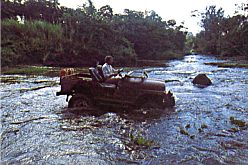
Jeep CJ-5 y parece ser que fueron adquiridos en Brasil. En aquel entonces,
estos Jeep no eran fabricados por AMC USA e importados a Brasil, ni eran
construidos en Brasil por AMC (recordemos que por aquel entonces AMC era
propietaria de Jeep). Los CJ-5 del Camel Trophy, fueron un modelo del
mercado brasileño, fabricados por FORD Brasil denominados U50.
Ford compró a Willys sus factorías de Brasil a finales de 1967, y siguió
construyendo los Jeep, pero bajo sus variaciones de diseño y mecánica.
Los Jeep del Camel Trophy de 1980 llevaban motor Ford 2.3L de gasolina,
que Ford comenzó a instalarlo en los Jeeps a mediados de los ´70,
tambien contaban con transmisión de 4 velocidades sincronizadas.
Ford continuó construyendo Jeeps en Brasil hasta 1983.
|
 |
New
details about the Jeeps used in Transamazonica thanks to David Hatherill
from the Camel Trophy Owners Club
It
would be easy to think that the vehicles used were straight forward Jeep
CJ5’s built at the company’s Toledo, Ohio plant, in the good ol’ U.S.
of A. as has been suggested before, but like most things related to Camel
Trophy, all is never as it seems. Having studied the vehicles there are a
number of features which do not make sense at all for
US
product. Firstly the vehicles were
81 inch wheelbase, although the American factory had stopped production of
these and extended the wheelbase to 84 inches in 1974. Secondly the
windscreen wiper motors were at the top of the windscreen, whereas US
models did not feature this even as late as 1970, Thirdly the shape of the
rear wheel arches did not correspond with any vehicles ever to roll out
the
Toledo
factory, and finally the canvas
top did not match any patterns produced in the
US
.
Basically
CJ5’s were, over the years, produced in a vast number of countries,
sometimes as CKD kits, but in other cases many parts and even complete
vehicles were locally produced. This accounts for the fact that many look
very different. One of these factories was in
Brazil
, home of the Transamazon highway,
so it comes as little surprise to find out that the Camel Trophy Jeeps
were in fact built there. The Brazilian factory was owned by Ford of
Brazil, and they had a license to produce a locally built CJ5 called a
Ford U-50.
Each
vehicle was equipped with 6.00 x 16 bar grip tyres, and carried a bonnet
mounted spare, which is very unusual for a Jeep, in addition to the side
mounted spare on the rear body tub. A Jerrican was carried each side in
front of the door. A large tubular bull bar was fitted on a more
substantial than normal bumper. Naturally for Camel Trophy four additional
lights were fitted, although they were attached to the bull bar rather
than the familiar roof rack position of the Land Rovers. And that’s
about it equipment wise. Military CJ5’s have a shovel mount on the
underside of the bonnet, these vehicles may have been the same.
They
were fitted with the original 3 speed transmission, which takes some
getting used to as reverse is where first would normally be, but this was
connected to a Ford engine rather than the more normal Willys Hurricane
unit, which by 1980 would have been very long in the tooth. The engine
used was a Ford inline 4 designated type 141 overhead cam unit, of 2.3
litre displacement, which must have provided quite reasonable performance
for such a light vehicle with 91 bhp on tap.....Yes folks, the Jeep is
lighter despite what Land Rover would tell you about Ali panels.
There
were three teams competing: all German, so no prizes for guessing which
country won. There’d be more prizes for guessing what support vehicles
were used. Unbelievably they appear to be Brazilian license built
Volkswagens, but so far I’ve failed to actually identify them.
The
event itself started from
Belem
near the Brazilian coast and
headed approximately west for 1600 kms to
Santarem
, taking 12 days to get
there. Unlike later events no standard livery was applied and one vehicle
was red, whilst the other two were yellow.
It has been stated in a few places that the vehicles were rented
from Hertz, but we have no evidence whether this was true or not. They
were lettered Camel Trans Amazonica on each side of the bonnet, and one is
known to have been burnt out during the course of the event. All in all
quite a low budget affair and very far removed from the later larger
events with attendant media circus.
"Este website no se relaciona con ni
tiene conexión con marcas de Wordlwide Brands Inc. ("WBI") que son
los dueños de la marca registrada CAMEL TROPHY. WBI no endosa este website ni
ninguno de sus contenidos."
"This website is not related to and has no
connection with Worldwide Brands Inc. ("WBI") which is the
registered trade mark owner of the CAMEL TROPHY trade mark. WBI does not
endorse this website nor any of the its contents"
|
|

